What Can a 5kVA Inverter Carry? AC, Pumping Machine and More
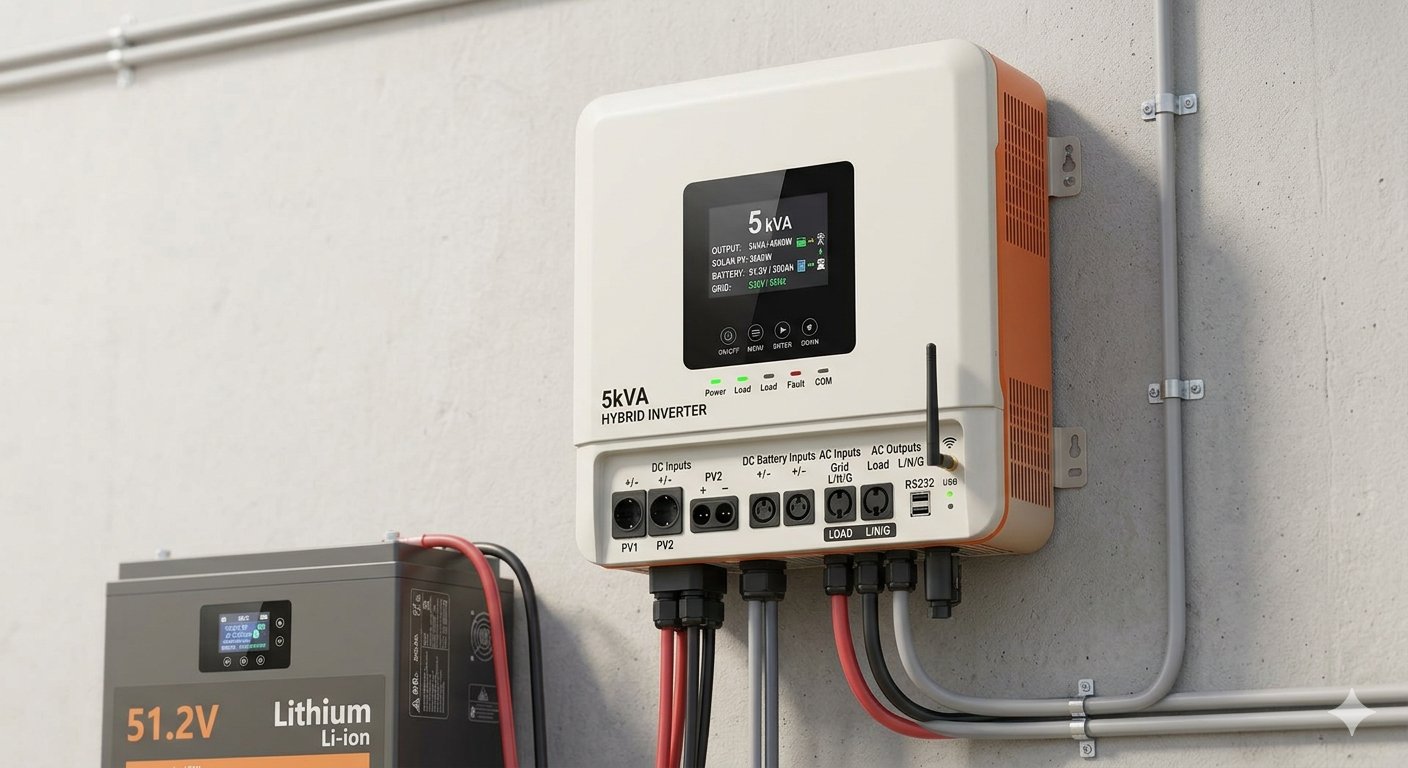
A 5kVA inverter is the size to look at when you want to run AC on backup, not only fans and lights. But "5kVA" on the box doesn't tell you what you can switch on when NEPA takes light. This guide covers what can a 5kVA inverter carry, appliance by appliance, how long the batteries last, and how many solar panels you need.
The short answer: a 5kVA inverter can carry a whole family home, including a 1.5HP inverter AC, a freezer and a pumping machine. What limits it most is battery size, not the inverter.
What 5kVA means in watts
Inverters are rated in kVA, but appliances are labelled in watts.
Older 5kVA inverters give about 4,000 watts (5 × 0.8). Many newer hybrid inverters give the full 5,000 watts. Look for "rated output power" on the label or in the manual. That watts figure is your true limit.
For everyday use, keep your running load under about 80% of it. That's roughly 3,200 watts on an older unit and 4,000 watts on a newer one. The spare room lets motors start without tripping the inverter.
Most 5kVA inverters run on a 48V battery bank. That's usually four 12V batteries in series, or one 48V lithium battery.
So, what can a 5kVA inverter carry?
These are typical figures. Check your own appliance labels, since models differ.
| Appliance | Typical running watts | Can a 5kVA carry it? |
|---|---|---|
| Lights, fans, TVs, router, chargers | 300 to 600W together | Yes |
| Fridge and chest freezer | 200 to 400W together | Yes |
| Washing machine (no hot wash) | 400 to 800W | Yes |
| Microwave | 1,000 to 1,500W | Yes |
| Pressing iron | 1,000 to 1,200W | Yes |
| 1HP inverter AC | 600 to 900W | Yes |
| 1.5HP inverter AC | 900 to 1,300W | Yes |
| 1.5HP non-inverter AC | 1,100 to 1,500W, with a big start-up surge | Usually, if little else is starting at the same time |
| 2HP inverter AC | 1,400 to 1,900W | Yes, but it drains the battery fast |
| Two 1HP inverter ACs | 1,200 to 1,800W together | Yes, with a large battery bank |
| 1HP to 1.5HP pumping machine | 750 to 1,100W, with a big start-up surge | Yes, with the ACs off while it starts |
| Water heater | 1,500 to 3,000W | Not on battery |
| Electric cooker or hot plate | 1,500 to 2,000W per ring | No |
Can a 5kVA inverter carry a 1.5HP AC?
Yes. If you want a 1.5HP AC on backup, this is the size to look at. A 1.5HP inverter AC runs comfortably, with room left for fans, lights, the fridge and the freezer.
A non-inverter AC pulls a large surge each time its compressor starts, often three to five times its running power. A 5kVA inverter can usually handle one of these. Trouble starts when the AC kicks in at the same moment as a pump or a microwave. If you're buying a new AC, an inverter type is kinder to your backup system.
Can a 5kVA inverter carry a 2HP AC?
It can start and run one. A 2HP inverter AC uses around 1,400 to 1,900 watts. Add the rest of the house and you are near the limit of an older 4,000-watt unit. The bigger issue is storage. At that load, a four-battery tubular bank will be flat in about two hours.
If you want a 2HP AC, or two ACs, running through the night, plan the battery bank around that first. A single 5kVA inverter can't make up for too little storage.
Can a 5kVA inverter carry a pumping machine?
Yes. A 1HP or 1.5HP pumping machine is fine on a 5kVA inverter. Pumps have a heavy start-up surge, so it's still wise to pump when the ACs are off, or during the day when the sun is strong and the panels are doing the work.
Pressing iron, microwave and washing machine
A 5kVA inverter carries all of these. You can run the washing machine and iron at the same time as your fans and fridge. Each of them takes a big bite out of the battery, so heavy chores are best done while there's light or sun.
What a 5kVA inverter should not carry
Water heaters, electric cookers, hot plates and electric kettles use 1,500 to 3,000 watts each. A 5kVA inverter may carry one briefly, but the batteries will drain very fast. Keep these on gas or on NEPA.
How long will the batteries last?
Here are rough figures for three common battery banks and two evening loads. The small load is about 500 watts (fans, lights, TV, fridge, router). The AC load adds a 1HP inverter AC, for about 1,200 watts total.
| Battery bank | Usable storage | 500W load | 1,200W load (with AC) |
|---|---|---|---|
| Four 12V 200Ah tubular | about 4.8kWh (half of 9.6kWh) | about 8 hours | about 3 to 4 hours |
| 48V 100Ah lithium | about 4.3kWh | about 7 to 8 hours | about 3 hours |
| 48V 200Ah lithium | about 8.5kWh | about 15 hours | about 6 to 7 hours |
Tubular batteries should only be run down to about half, or they wear out quickly. Lithium batteries can be run much lower. So a lithium battery gives more usable power for its size. For more detail, see our guide on lithium vs tubular batteries.
If you want AC all night, the 48V 200Ah lithium bank (or two 100Ah units) is the practical minimum.
How many solar panels for a 5kVA inverter?
For most Lagos homes, 6 to 10 panels of 450 to 550 watts each is a good range. That's about 2,700 to 5,500 watts of panels.
Lagos gets around 4 peak sun hours a day over the year. In the rainy months of July and August that can fall to about 3. After heat, dust and wiring losses, each 550-watt panel gives around 1.2 to 1.6kWh a day. Six of them can refill a 5kWh battery and run your daytime load on most days. Go toward ten if you run an AC in the daytime or have a bigger battery bank.
Check two things before buying panels:
- The inverter's solar input limit. Look for "max PV input power" on the label. Many 5kVA hybrids accept 5,000 to 6,500 watts of panels, but some accept less. Panels above the limit add nothing.
- The voltage limit. Panels are wired in strings, and each string's voltage must stay under the inverter's maximum PV voltage. This is a job for your installer, not guesswork, because going over it can damage the inverter.
5kVA or 3.5kVA?
Choose a 3.5kVA if your home runs fans, lights, TVs, a fridge and a freezer, with maybe one small inverter AC now and then. Our 3.5kVA inverter guide covers that size in full.
Choose a 5kVA if you want a 1.5HP AC on backup, run a pumping machine often, or have a large family with lots going on at once. Also choose it if you plan to add more batteries or panels later. Moving up to 5kVA later usually means replacing the inverter, so buying the right size once saves money.
Signs your 5kVA is overloaded
- An "overload" warning or beeping when the AC or pump starts
- The inverter switching off, then back on
- Batteries flat hours before NEPA comes back
- Heat or a burning smell near the inverter, batteries or cables
The last one needs attention straight away. Switch off the heavy loads and call your installer. Our maintenance and repair service covers inverter checks like this.
Size the system around your home
A 5kVA inverter is a good fit for many Lagos homes, but the right system depends on what you run and when. The battery bank and panels matter as much as the inverter.
You can send us your appliance list on WhatsApp and ask questions for free. When you're ready, get a quote. We'll book a site assessment, look at your wiring and load, and give you a written plan for your inverter installation.
21 Questions to Ask Before You Pay an Inverter Installer in Lagos
A step-by-step list of what to check before, during, and after your installation, so you never end up paying for someone else's guesswork.